R6bn earmarked for investment in electricity infrastructure for service delivery
21 July 2026
The City of Hope Budget 2026/27 places the spotlight on unprecedented infrastructure spend for Cape Town over the medium-term (three-year) budget framework. This includes the Energy Directorate’s R6 billion investment in electricity infrastructure over this period to secure supply and make it more reliable and affordable by reducing the Eskom-impact on pricing and adding cleaner sources of energy to the mix. The City’s capital budget shows about 70 cents in every Rand will be spent on infrastructure assets, such as electrical, roads and transport, sanitation, stormwater, water supply and coastal infrastructure.
The largest component of the City’s capital investment through our Energy Directorate is the over R6 billion in electricity grid upgrades and clean energy procurement to prepare Cape Town’s infrastructure for a dynamic, decentralised energy future. This includes a R1bn investment in streetlights over the next three years.
‘All of our attention is fixed on expanding and improving access to our services and to bring down costs for customers. To achieve this, council has approved a budget, which includes a record R6bn capital investment to maintain reliability of supply and move our City steadily towards our Energy Strategy objectives amid a fast-changing electricity environment. Much of our infrastructure investment is only possible with the tariff contributions from our customers.
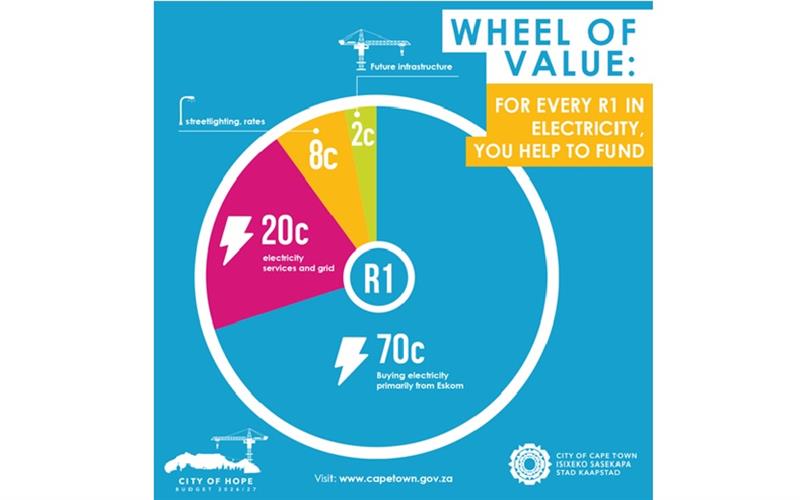
‘As a power distributor, the Energy’s Directorate’s largest expense is to buy bulk energy from Eskom – of all our tariff income, some 70% of it goes to Eskom. This is the largest driver for the cost of electricity and thus the impact it has on tariffs. Despite these external shocks, the City continues to shield residents by absorbing some of the increases to offer relief to all residents, particularly those in need of it the most.
‘The National Energy Regulator approved an increase of 8,76% for Eskom resulting in a corresponding Eskom municipal tariff increase of 9,01%. The City managed to limit this to 6,64% residential average increase is 2,37 percentage points lower than the Eskom increase to municipalities. Our strategic approach is anchored on ways to reduce Eskom’s enormous price impacts on our operations, and thus on our customers while ensuring that we invest enough in the upgrade, maintenance and future-fitting of our service delivery to prevent the decay that we see elsewhere in our country.
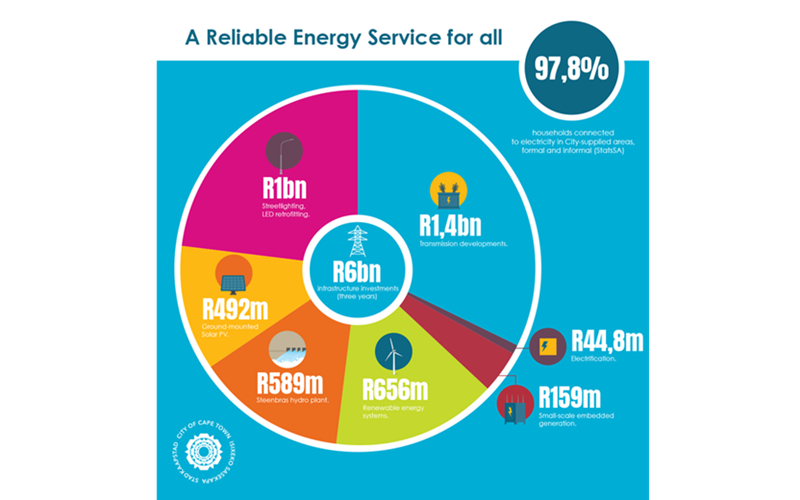
‘Our metro boasts pioneering and some of the most advanced energy security investments that have been made over the past three years and this work continues over the medium-term. This includes R1,8 billion for energy-secure service delivery, including R656 million for renewable energy generation systems and R589 million for the Steenbras hydro plant to help with energy security and to reduce the reliance on Eskom by diversifying our energy sources.
‘There is also an allocation of R159 million to support small-scale embedded generation and R59 million earmarked for the very successful municipal efficiency programme.
‘Some R165 million is earmarked to replace ageing streetlights with energy efficient LED technology. Our teams also work hard to electrify communities that still require access to electricity with R44,8 million to be spent over the next three years. In City-supplied areas, more than 97,8% (StatsSA data)of households, including informal settlements where it is feasible to do so, have been connected to the grid,’ said the City’s Mayoral Committee Member for Energy, Alderman Xanthea Limberg.
Highlights
- Ground-mounted Solar PV Project – R492m (2027/29 – 2028/29)
- City-wide electrification: R44,8 m (medium-term) including also Imizamo Yethu, Lavender Hill and Nomzamo and individual prepaid meters to households in informal settlements and backyards to restore dignity and quality of life, reduce fire risk from illegal connections.
- Street- and public lighting: R261,5m (2026/27 – 2028/29)
- Service connections across the City: R309,6 m (2026/27 – 2028/29)
- Various city-wide transmission system developments: R1,4 bn (2026/27 – 2028/29) earmarked for among others:
- Grassy Park HV network rearrangement
- Gugulethu-Mitchells Plain 132kV line underground
- New Monte Vista main substation
- Oakdale 132kV upgrade
- Paardevlei 132/66 kV stepdown
- Triangle 132kV upgrade
- Woodstock 132 kV GIS replacement
Energy Strategy
The budget supports the 2050 Energy Strategy for Cape Town’s Shared Energy Future, adopted in 2023. Please also visit
www.capetown.gov.za/SOEC for more information on the State of Energy and Carbon 2025 report.
End
Published by:
City of Cape Town, Media Office